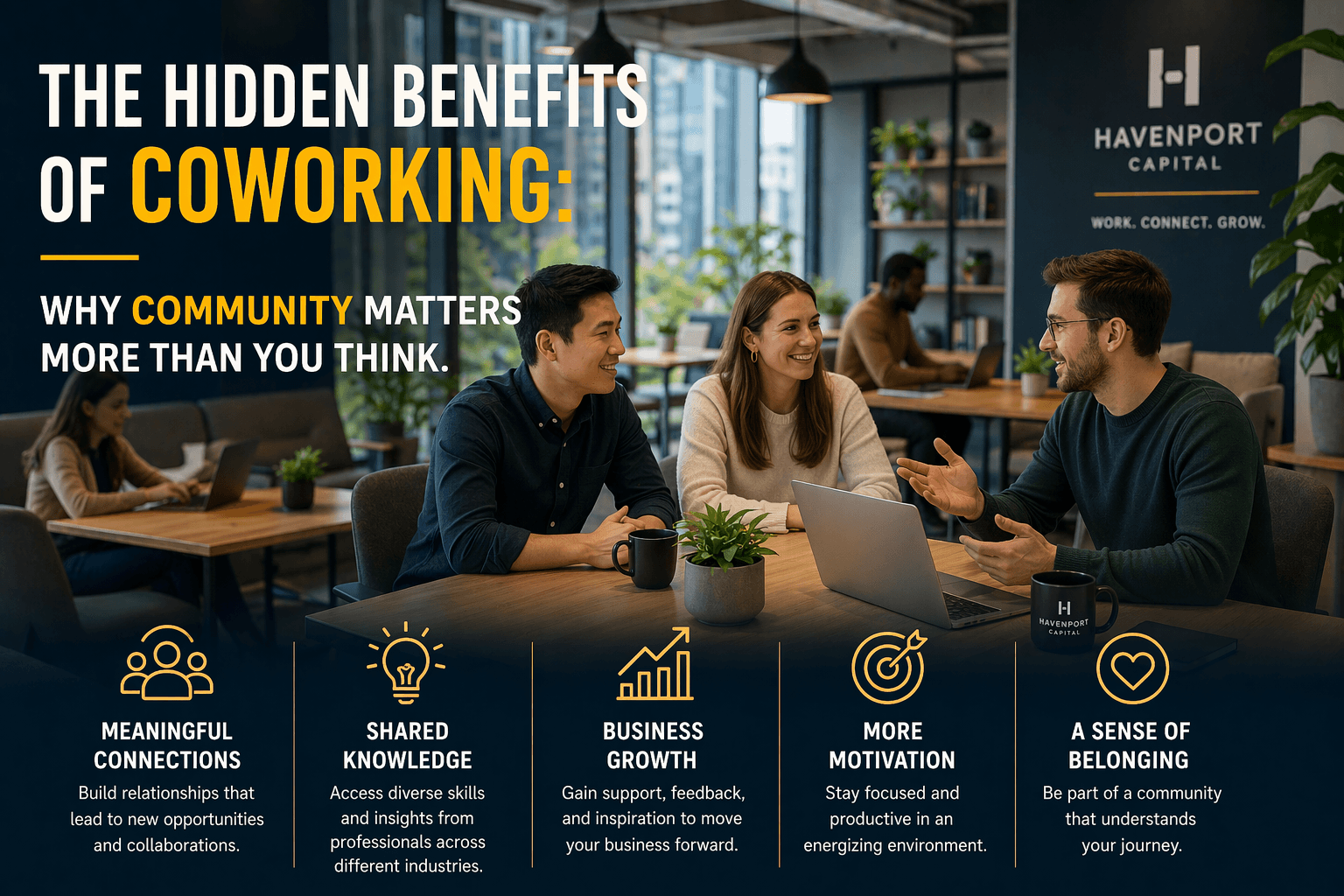
For many professionals, coworking is initially a practical decision. It offers flexibility, predictable costs, and a ready-to-use workspace without long-term commitments. Especially for international founders entering the U.S. market, it often serves as a straightforward alternative to traditional office leases.
What tends to be overlooked at first is the role of community.
Not in a superficial sense, but as a functional part of how work happens. Over time, the people around you—who they are, what they do, and how often you interact—start to influence productivity, decision-making, and even the pace at which a business develops.
This is where coworking reveals a layer that is less obvious, but often more valuable than the workspace itself.
Work becomes less isolated—and more structured
Working independently has clear advantages, particularly in the early stages of a business. It allows for focus, autonomy, and efficient decision-making without unnecessary input.
However, prolonged isolation tends to introduce subtle friction.
Without regular interaction, feedback loops become slower. Small uncertainties take longer to resolve. Even routine decisions can feel more time-consuming when there is no immediate point of reference.
Coworking environments introduce a form of passive structure. Being surrounded by others who are also working creates a natural rhythm. It is not enforced, but it is noticeable.
This kind of environment often leads to more consistent work patterns, even without direct collaboration.
Informal interactions often lead to practical outcomes
Most valuable business conversations are not scheduled in advance.
They happen in between. A short exchange in a shared kitchen. A quick question before a meeting. A casual discussion that starts without a clear objective.
In traditional office settings, these interactions are usually limited to internal teams. In coworking spaces, they extend across industries and backgrounds.
A freelance developer might sit next to a logistics consultant. A small e-commerce founder might share a space with someone experienced in U.S. compliance or operations.
These overlaps create opportunities that are difficult to plan but easy to benefit from.
Not every interaction leads to a direct result. But over time, the accumulation of small exchanges often leads to better decisions, faster problem-solving, and occasionally, new business relationships.
Professional presence develops naturally
One of the less discussed aspects of coworking is how it shapes professional behavior.
Working from home often requires a deliberate effort to maintain structure—setting boundaries, managing time, and creating a focused environment. In a shared workspace, many of these elements are built into the setting itself.
Meetings take place in designated rooms. Work happens at a defined desk. The day has a clearer beginning and end.
This does not impose rigidity, but it does encourage consistency.
Over time, this consistency translates into how work is presented to clients and partners. Conversations become more focused, meetings more structured, and communication more deliberate.
The environment supports these changes without requiring constant effort.
Access to a broader skill set without formal hiring
For growing businesses, one of the most challenging aspects is knowing when to bring in additional expertise.
Hiring too early creates unnecessary cost. Waiting too long slows progress.
Coworking spaces provide an informal alternative.
Within a shared environment, it is common to encounter professionals with a wide range of specializations—marketing, legal support, finance, operations, and more. While these are not formal team members, they are often accessible for quick input or initial discussions.
This can be particularly valuable for international entrepreneurs navigating a new market. Instead of relying solely on external consultants, they gain proximity to people who understand local conditions and can offer practical insights.
It is not a replacement for structured partnerships, but it often serves as a useful starting point.
Motivation becomes more sustainable over time
Sustaining motivation is rarely about intensity. It is about consistency.
Working alone, especially over extended periods, can lead to fluctuations in focus and energy. Some days are highly productive, others less so, with little external influence to stabilize the pattern.
Coworking introduces a subtle but effective form of accountability.
Seeing others work, progress, and engage with their own projects creates a shared sense of momentum. It is not competitive in a direct sense, but it reinforces a baseline level of activity.
This makes it easier to maintain steady progress over time, even during less structured phases of a business.
A practical environment for testing and adapting
For many businesses, particularly those entering a new market like Florida, flexibility is not just a preference. It is a requirement.
Coworking spaces provide an environment where different ways of working can be tested without long-term consequences.
- Trying out new routines or schedules
- Hosting occasional meetings or small events
- Expanding from solo work to small team collaboration
Each of these adjustments can be made gradually, without committing to a fixed structure too early.
For professionals considering workspace options in locations such as Fort Myers or Miami, flexible coworking environments offer a way to explore what works best before making larger operational decisions.
Why community tends to matter more over time
At first glance, coworking appears to be about space. Desks, meeting rooms, and flexible access.
Over time, that perspective shifts.
The physical environment remains important, but it becomes secondary to how work is supported on a day-to-day basis. The presence of others—working independently but within the same space—creates a context that is difficult to replicate elsewhere.
This context influences how quickly problems are solved, how ideas develop, and how consistently work progresses.
Community, in this sense, is not an added feature. It is part of the infrastructure.
Moving forward with the right environment
Choosing a workspace is rarely a purely logistical decision. It shapes how work is approached, how relationships develop, and how a business evolves over time.
For those currently working in isolation or considering a more structured environment, coworking offers a way to introduce that structure without unnecessary complexity.
Exploring different setups—whether through occasional use, shared spaces, or private offices within a coworking environment—can provide clarity on what supports the next stage of growth.
And in many cases, the most valuable outcome is not just where the work happens, but how it improves once the right environment is in place.