At the beginning, working from home feels efficient. No commute, no overhead, full control over your environment. For many founders and remote professionals, it’s the most practical starting point.
But over time, something shifts.
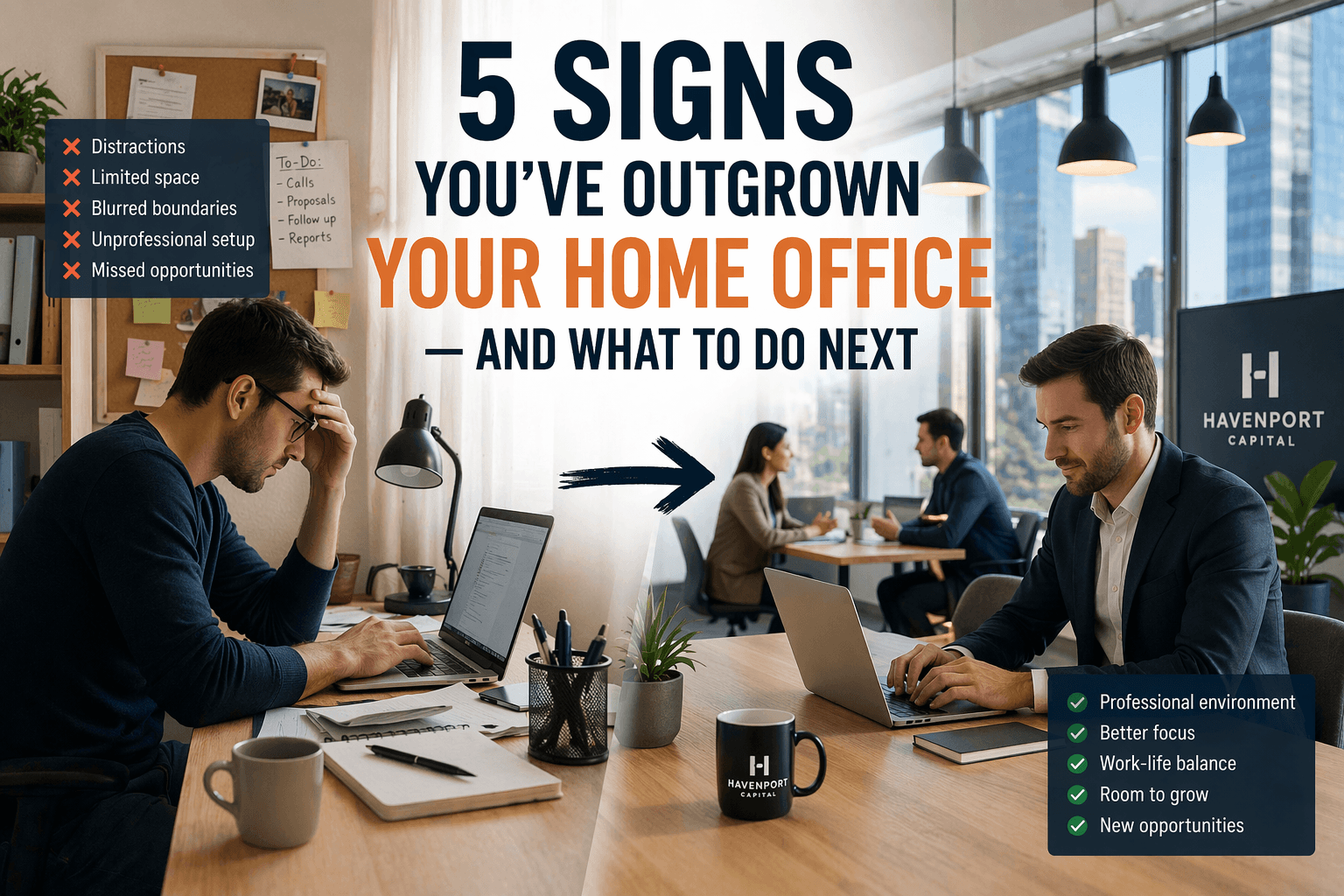
The same setup that once gave you flexibility starts to create friction. Calls become harder to manage, boundaries blur, and growth begins to feel constrained by your physical space. This is usually the point where the question changes—from “Can I work from home?” to “Should I still be working from home?”
Recognizing that moment early can save time, money, and missed opportunities.
Productivity no longer feels consistent
In the early stages, a home office often supports deep focus. Fewer interruptions, a familiar environment, and full autonomy can lead to highly productive days.
That changes once your workload becomes more complex. More calls, more coordination, more moving parts. What used to be a quiet workspace now competes with everyday life—deliveries, background noise, or simply the mental overlap between work and personal routines.
Productivity doesn’t collapse overnight. It becomes inconsistent.
Some days still work well. Others don’t. And over time, that inconsistency starts to affect output, deadlines, and overall performance.
A dedicated workspace outside the home doesn’t just remove distractions. It creates structure—something that becomes increasingly valuable as responsibilities grow.
Client interactions start to feel limiting
At some point, business becomes more outward-facing. Calls turn into meetings, and meetings occasionally need a more professional setting.
This is where the home office begins to show its limits.
Video calls can only carry so much. Backgrounds are controlled, but still informal. And while many clients are understanding, there is a subtle difference between “working remotely” and presenting a structured business environment.
Consider a simple scenario: a potential partner visiting from abroad. Meeting in a kitchen or living room changes the dynamic, even if the conversation itself is strong.
Professional space signals readiness. Not in an exaggerated way, but in a quiet, credible one.
Growth creates spatial pressure
Growth rarely announces itself clearly. It shows up in small ways.
An extra monitor. A second chair for occasional collaboration. Equipment that no longer fits neatly into a corner of the room. What started as a minimal setup gradually takes over more space than intended.
For solo professionals, this can feel manageable for a while. For small teams or partnerships, it becomes a constraint.
Working side by side in a home environment introduces new challenges—privacy, focus, and simple logistics. Conversations overlap. Storage becomes an issue. The physical setup no longer supports the way the business operates.
At this stage, the question is less about comfort and more about capacity.
Work-life boundaries begin to blur
One of the most underestimated effects of a home office is the lack of separation between work and personal life.
In the beginning, this often feels like an advantage. Flexible hours, quick transitions, and the ability to integrate work into daily routines.
Over time, the opposite tends to happen.
Work extends into evenings without clear stopping points. Personal space starts to feel like an extension of the office. Even when not working, there is a constant visual reminder of unfinished tasks.
This isn’t just about comfort. It affects long-term performance.
Clear physical separation—leaving a workspace at the end of the day—helps create mental boundaries that are difficult to replicate at home. And those boundaries become increasingly important as responsibilities grow.
You start turning down opportunities
This is usually the most telling sign.
Not because of strategy, but because of setup.
Opportunities that require in-person meetings, small team sessions, or a professional environment begin to feel inconvenient. Not impossible, but harder to execute. And sometimes, quietly declined.
It might be a workshop, a client presentation, or a collaboration that would require space you simply don’t have.
Individually, these decisions seem minor. Over time, they shape the direction of the business.
Growth is not only about what you pursue. It’s also about what your setup allows you to pursue.
What to do next: moving beyond the home office
Outgrowing a home office doesn’t automatically mean committing to a long-term lease. For many businesses, especially those in transition, that step comes with unnecessary risk.
A more practical approach is to introduce flexibility before making permanent decisions.
This can take several forms:
- Using coworking spaces for focused workdays
- Booking meeting rooms when needed
- Gradually transitioning into a private office as demand increases
This kind of setup allows businesses to adapt their environment to their current stage, rather than locking into assumptions about the future.
For professionals operating in Florida, flexible workspace options in Fort Myers and Miami offer a structured environment without long-term commitments. It’s a way to test what works before making larger decisions.
Making the shift at the right time
There is no fixed point at which a home office stops working. For some, it remains effective for years. For others, the limitations appear quickly as the business evolves.
The key is not to wait for clear failure.
Most transitions happen gradually. A few disrupted calls. A missed opportunity. A growing sense that the current setup is no longer aligned with how the business operates.
Recognizing these signals early creates room to adjust—without pressure, and without unnecessary cost.
Because the workspace itself is rarely the goal. It’s simply the environment that supports everything else.